Repair the control unit instead of replacing on suspicion
Limp mode, no-start, or a "control unit defective" verdict from another workshop? Before you order a new part, we determine whether the unit itself is the real cause — or whether the fault lies in a sensor, wiring harness, or connector. Your first step is a request, not a package: the unit stays in the vehicle.
Before you remove anything
Three answers before you remove anything
Is it really the control unit?
A fault code often describes a symptom, not the root cause. Every case starts with your submission request — the unit stays in the vehicle. If your description points toward a sensor, harness, or connector issue, we tell you before you ship anything.
What does the check cost if nothing is repairable?
If no repair is needed, only the inbound diagnostic flat fee applies — no repair or cloning costs are incurred. If work is required, you receive a written quote with a binding fixed price after the initial diagnosis. Nothing is done until you approve.
How long is your unit in transit?
From receipt, expect one to three business days in most cases: findings, repair or cloning, function test, and return shipping. The cloning process alone takes two to four hours depending on unit type and data volume. Rare components or complex hardware damage may take longer — we communicate the planned timeframe after the first diagnosis, before your approval.
The decision path
Repair, clone, or new — the decision tree
Board damaged, memory intact
The common case: solder joints, output stages, capacitors, or traces are defective, but the stored data is intact. We repair your original control unit — coding, VIN, and immobilizer data remain unchanged, so no recoding on the vehicle is needed.
Repair uneconomical, memory readable
If the hardware is too badly damaged but the memory can still be read, we transfer the complete software to identical replacement hardware. The unit takes over the stored identity and configuration — usually nothing needs to be re-learned on the vehicle.
Memory destroyed or encrypted new generation
If the memory is destroyed or the unit belongs to an encrypted, non-clonable new generation, a new part remains. It won't run by simply plugging it in: modern units are bound to the individual vehicle via component protection, and safety-relevant functions are unlocked at the manufacturer server. We handle the adaptation and variant coding to match the actual vehicle configuration.
Board-level repair
What we actually do on the board
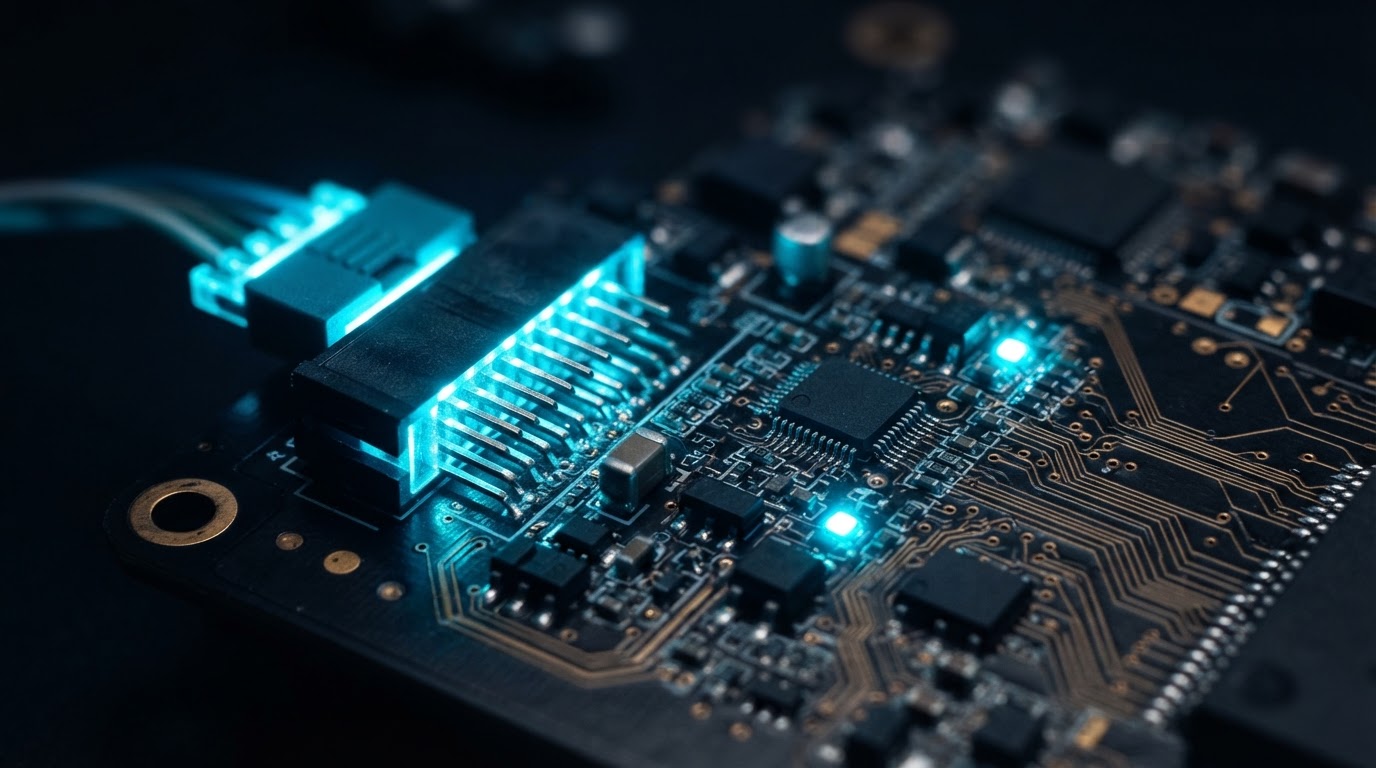
"Control unit repair" at RazTech does not mean ordering a replacement. We open the housing, expose the printed circuit board, and fix the actual defect — with measurement technology, a stereo microscope, and controlled soldering. Four fault patterns keep coming back:
Cold and cracked solder joints
Temperature cycles and vibration break solder connections over the years — the unit fails sporadically, often dependent on heat or shock. We localize the affected connections and re-solder them under the microscope, via reflow or targeted rework, including inspection of surrounding solder points.
Defective voltage regulators and driver stages
A shorted actuator or overvoltage burns out output stages, driver transistors, and voltage regulators. We measure the affected stages, identify the destroyed component, and replace it with a new one of equal or better specification — the rest of the board remains untouched.
Corroded traces after water damage
When moisture penetrates the housing or connector area, corrosion and electrolysis degrade the traces. We clean the board in an ultrasonic bath, remove corrosion residue, and professionally restore interrupted traces before the unit is sealed and tested.
Aged electrolytic capacitors
Electrolytic capacitors lose capacity or leak with age — the result is unstable supply voltages and seemingly inexplicable dropouts. We replace aged capacitors with long-life types rated for higher temperatures and verify the voltage supply under load afterward.
Two repair cases
Real board-level repair outcomes
Submission service
How the submission works
Request first, package second. You keep control at every step — nothing is shipped or repaired until we confirm and you approve.
Submit your request
Send us your case details — the unit stays in the vehicle. We review and confirm before you ship anything.
Receive a written findings report
After the inbound diagnosis, you get a written report and a binding fixed-price quote. You decide on the next step.
Repair or cloning
Once approved, we perform the board-level repair or transfer the software to replacement hardware — coding and immobilizer data preserved.
Return with documentation
Function-tested and returned with full documentation. Typically one to three business days from receipt.
Have a question about your case? Contact our engineering team instead.
Related services