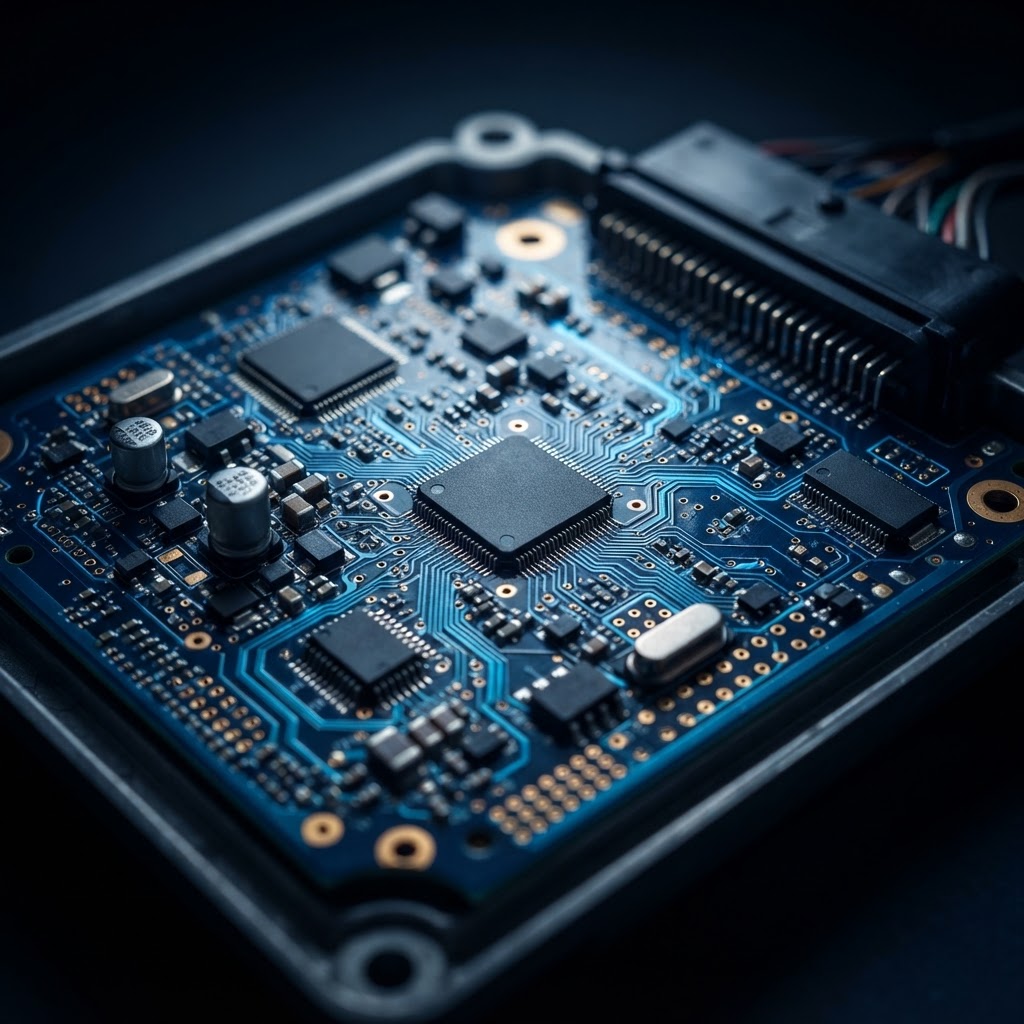
The EPC symbol lights up on the instrument cluster, the engine runs rough, drops into limp mode or won't start at all. The EPC warning light is one of the most common messages in the Volkswagen Group – and often one of the trickiest for workshops. What EPC means, how to narrow down the cause systematically, and when the engine control unit itself is affected.
What does the EPC warning light mean?
EPC stands for Electronic Power Control and refers to the vehicle's electronic engine power management in the VW Group: VW, Audi, Seat and Škoda. When the symbol lights up permanently, the engine control unit (ECU) has detected a fault in this system and usually switches to limp mode. The engine then only accepts throttled input or does not respond to the accelerator pedal at all. If the light flashes or appears together with other warning symbols, immediate attention is required.
Typical causes when EPC lights up
- Throttle body and throttle actuator: Faulty position sensors or a sticking actuator in the throttle body unit are among the classic triggers, often with fault codes such as P0638 or P2101.
- Accelerator pedal sensors: The VW Group's electronic throttle uses redundant pedal sensors. If they deliver contradictory values, EPC lights up.
- Brake light switch: An often overlooked culprit whose fault code rarely points directly to it.
- Sensors: Implausible signals from the mass air flow sensor, crankshaft sensor or ignition coils also throw the engine power management off balance.
- Wiring and connectors: Corroded plugs, broken wires or poor ground connections imitate an ECU failure at first glance.
- The engine control unit itself: internal faults, for example after water ingress, voltage spikes from an improper jump start, or failed driver stages for throttle and valves.
How workshops narrow down the cause systematically
- Read out and document the fault memory. Which codes are stored, and in which condition does the fault occur – cold, warm, under load or at idle?
- Reproduce the symptoms. A recurring EPC warning without a clear finding points rather to wiring or the ECU, clear sensor faults to the affected component.
- Measure the electrics before replacing parts. Check supply, ground and signal lines to the throttle body and the pedal. A large share of all EPC cases is wiring-related.
- Only when sensors and electrics are clean does the engine control unit remain as the cause.
When is the ECU itself the cause?
- EPC lights up again and again without any external component showing up
- The diagnostic tester occasionally reports "ECU not reachable" – communication with the control unit drops out
- Cylinder-specific misfires or limp mode without a plausible sensor finding
- The fault appeared immediately after an event that stressed the electronics: jump start, water in the engine bay, thermal stress
In these cases the fault is often located on the board: failed driver stages, capacitors or solder joints. Board-level repair starts exactly here.
Repair instead of replacement
Once the engine control unit is confirmed as the cause, a new unit is not the only way. The fault can often be fixed directly on the board – the original unit is retained, coding, adaptations and vehicle binding do not have to be rebuilt. Preparing a replacement unit by cloning is also an option.
How it works for workshops
- Describe the fault: symptoms, stored fault codes, vehicle and control unit model – most easily via our submission portal.
- We get back to you with a fixed-price quote.
- After approval, send in the unit. Processing usually takes 2 to 3 working days after we receive the unit, plus shipping time. You get 12 months of warranty on the repair work. We do not offer express processing.
We are available Monday to Friday from 9 am to 6 pm. More about the process and our ECU repair services.
Conclusion
A lit EPC warning light is always a signal from the engine power management – but it by no means always means a broken sensor. With a systematic diagnosis the cause can be narrowed down reliably. If the engine control unit is what remains at the end, board-level repair is in most cases the faster and more economical solution: submit your request directly via the portal.