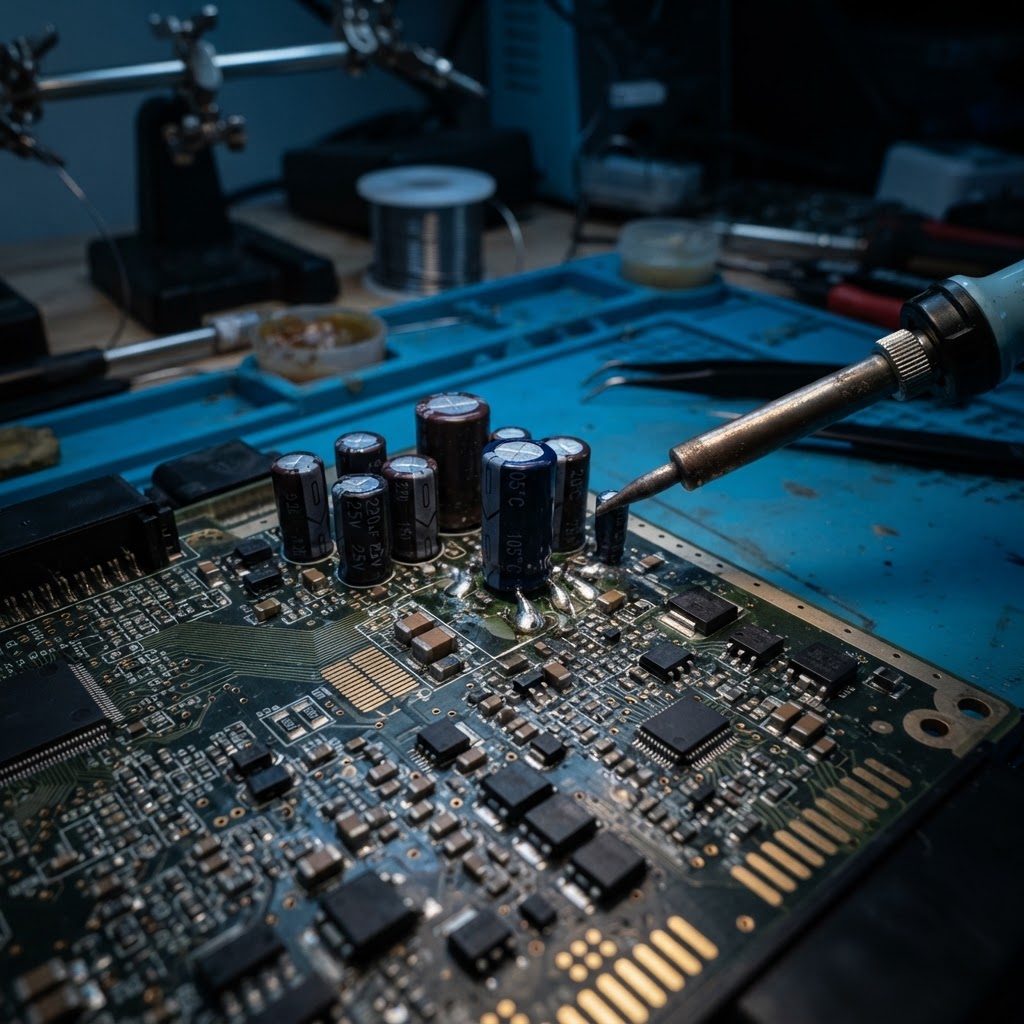
Not every ECU defect is spectacular. Some creep in over months: intermittent starting, OBD communication drops, fault codes that return after clearing. The cause is often aging electrolytic capacitors in MED17 and Simos control units.
Not every ECU defect is spectacular. Some creep in over months: the vehicle starts right away one time, and only on the third attempt the next. OBD diagnosis breaks off without any recognisable reason. Fault codes can be cleared, but return after a few trips. Workshops then often look in the wrong place — sensor, wiring harness, relay — until finally the engine control unit comes under suspicion.
The cause: aging electrolytic capacitors in MED17 and Simos control units. These components have a limited service life. With increasing operating hours and thermal stress, they lose their capacitance. The result: the supply voltage inside the control unit becomes unstable and internal communication fails.
Typical symptoms of a capacitor failure:
- The control unit sometimes cannot be addressed via OBD
- Sporadic starting problems, especially with a cold or very hot engine
- Fault codes are present, disappear after clearing, but return
- No clear assignment to a sensor or actuator
The good news: a capacitor failure is a standard repair. The affected electrolytic capacitors are identified and replaced at board level. The original unit is retained — coding, immobiliser and adaptations do not need to be re-adapted. Plug-and-play after refitting.
Important: the earlier the defect is detected, the better. An unstable capacitor can stress further components on the board over time. Anyone who continues driving for a long time risks consequential damage. If the described symptoms occur, the control unit should be checked early. Via the mail-in service the unit can be sent in directly with vehicle data and a fault log.