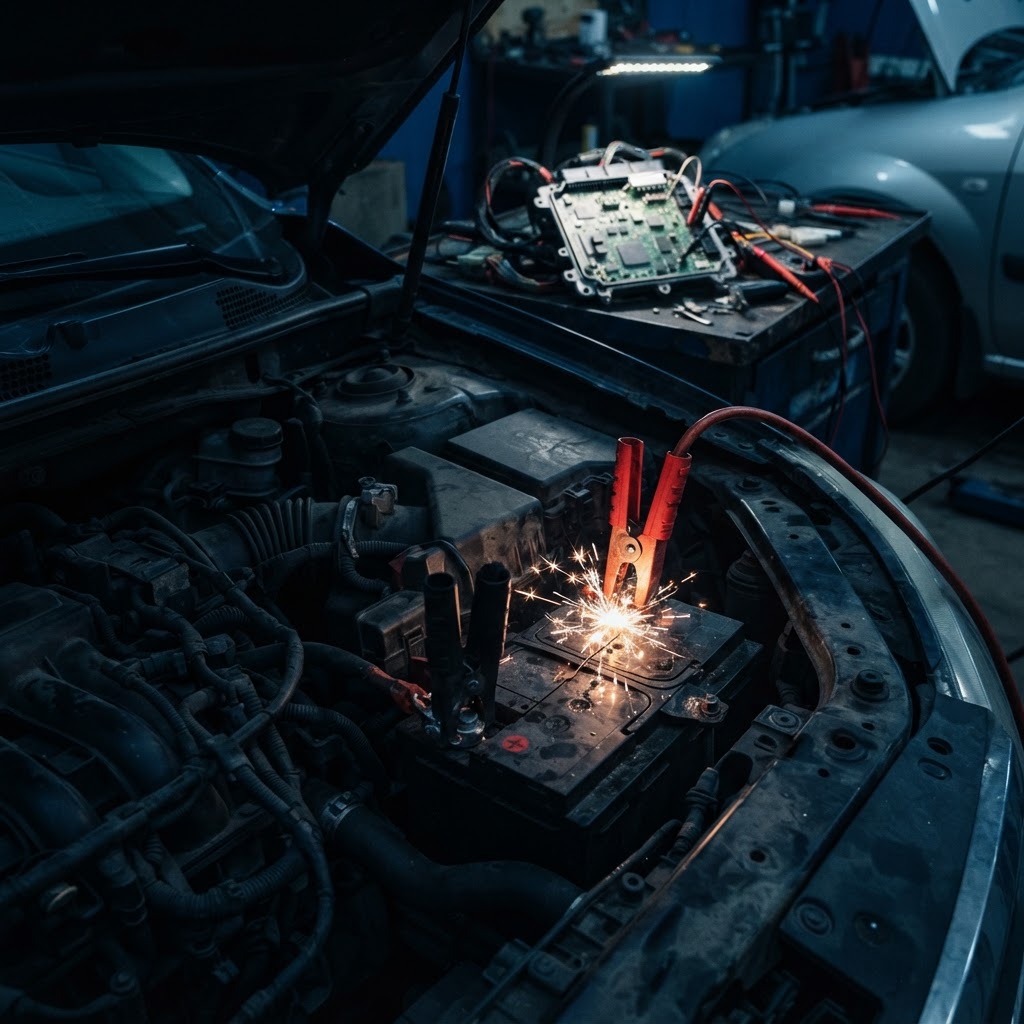
The quick jump start from another vehicle — and afterwards the engine still won't fire. Worse: the car suddenly shows faults that weren't there before. What many don't know: improper jump starting can damage the engine control unit.
The quick jump start from another vehicle — and afterwards the engine still won't fire. Worse still: the car suddenly shows faults that weren't there before. What many don't know: improper jump starting can damage the engine control unit.
The cause is voltage spikes. If the jump start is carried out with the donor vehicle running or with incorrectly polarised cables, short voltage spikes of well over 14 volts can enter the vehicle network and the control unit. Cheap boosters without voltage regulation are also a common source. The sensitive electronics in the engine control unit — driver stages, communication ICs, power supply — cannot withstand these spikes indefinitely.
Typical symptoms after a jump start:
- Engine no longer starts, even though the battery is charged
- New fault codes without any recognisable mechanical defect
- Communication with the control unit drops out or is unstable
- Cylinder-selective misfires after the jump start
This is how workshops avoid the damage: only perform jump starts with cleanly connected, correctly polarised cables. Do not let the donor vehicle run during the jump start. Use quality boosters with regulated voltage. After the jump start, read out and document the fault memory.
The good news: a control unit damaged by voltage spikes is repairable in many cases. The affected components can be identified and replaced at board level — the original unit is retained, coding and adaptations do not need to be re-adapted. Via the mail-in service the unit can be sent in directly with a fault log and vehicle history.