Control Unit Repair Cost: What Does an ECU Repair Really Cost?
What does a control-unit repair cost? Fixed prices, typical defects and a comparison with a new part – transparent cost breakdown for EDC17, MED17, DME/DDE engine control units.
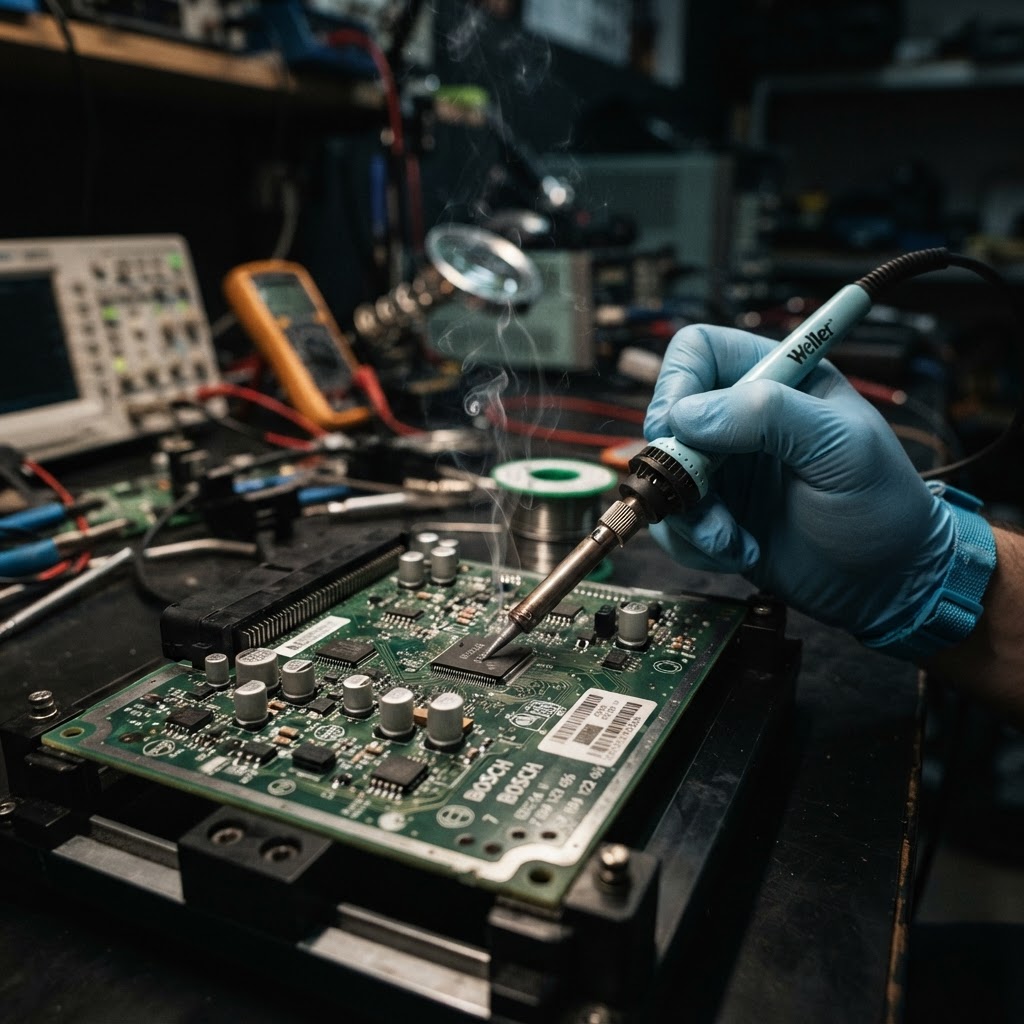
The question of cost is the first one workshops and vehicle owners ask when the engine control unit is defective. And it's justified: a new control unit quickly costs €800 to €2,500 – plus coding, plus possibly a trip to the dealer. A repair is in most cases significantly cheaper. But what exactly does it cost? Here's an honest overview, without empty promises.
Why there's no flat fixed price
Every defect is different. A burned-out injector driver on an EDC17 is a different repair from a water-damaged MED17 with a corroded board. That's why we work with a fixed price after diagnosis – not a "from X euros" that ends up twice as expensive.
What we need up front to name the price:
- Vehicle data – make, model, year, engine code
- Fault pattern – fault codes, symptoms, what works, what doesn't
- Control-unit part number – the part number on the housing (important for exact identification)
Via our mail-in service you can submit this data directly and receive an initial assessment with a price frame within one working day.
Typical cost blocks – transparently broken down
Diagnosis and testing
After receipt the unit is tested: visual inspection, pin check, communication via OBD/K-Line/CAN, testing under load. Only then do we know what's actually defective.
The repair itself
Depending on the defect, the following apply:
- Population and components – voltage regulators, capacitors, driver ICs, relays
- Soldering work – component replacement at board level, repair of cold solder joints
- Cleaning and sealing – especially after water damage: removal of corrosion, protective sealing of the board
- Function test – the repaired unit is tested under load again before it goes back
Shipping
Outbound and return shipping within Germany. For time-critical repairs, express shipping is possible.
Comparison: repair vs. new part
| New part | Repair | |
|---|---|---|
| Part costs | €800–2,500 | well below |
| Coding | strictly necessary | not needed – your own unit |
| Immobiliser | re-learn | stays intact |
| New-part lead time | often 1–3 weeks | a few days after receipt |
| Risk | coding errors, compatibility | low – same hardware |
The saving is typically 50–70 % compared with a new part plus coding – on many defects even more.
When the repair doesn't pay off
Honesty is part of it: not every control unit is repairable. If the board is completely destroyed by fire or mechanical force, no repair helps. In those cases we say so directly – you only pay the inspection that was carried out, not a repair that doesn't exist.
What happens if your ECU is beyond repair?
If a control unit is severely damaged by fire, water intrusion, or mechanical force, hardware repair is no longer feasible. In these cases, we perform a Full 1:1 ECU Cloning.
What does ECU cloning mean?
Cloning is the process of fully extracting all digital data from the defective original control unit (donor data / original software) and writing it identically into a donor ECU (second-hand) with a compatible hardware code.
Through 1:1 cloning, the new control unit becomes an exact copy of the old one. This means the car starts directly without expensive adaptations at the dealership, without reprogramming the keys, and without recalibrating the immobiliser (immobiliser stays intact).
How the process works — step by step at RazTech
1. Identification & acquisition of the donor part (Donor ECU) A second-hand control unit with the same hardware specifications (HW number, e.g. Bosch EDC16C39 or EDC17CP14) is sourced.
2. Bench connection (Bench / Boot / BDM mode) Using high-precision equipment, we connect directly to the pins of the original ECU on the bench, without risking further damage to the processor. If the main chip is still readable, the data is extracted digitally.
3. Reading and saving the memories (full backup) The two major memory components are extracted:
- MPC / Flash (operating software): contains the injection maps, fault codes (DTC), vehicle configuration and engine parameters.
- EEPROM (security data): contains the VIN code (chassis number), immobiliser data (IMMO data), injector coding and mileage.
4. Writing to the new ECU (donor unit) The complete memory (Flash + EEPROM) extracted from the defective ECU is written (flashed) into the new donor control unit. An automatic checksum correction is performed to prevent start-up errors.
5. Verification & bench testing Before delivery, the new ECU is verified on the test bench for CAN communication, current consumption and software stability.
How to get your fixed price
- Submit the fault pattern and vehicle data via the Control Unit Submit
- Initial assessment with a price frame within one working day
- On approval: send the unit in, have it repaired, get it back
No risk, no hidden costs. Just send the data – we'll handle the rest.